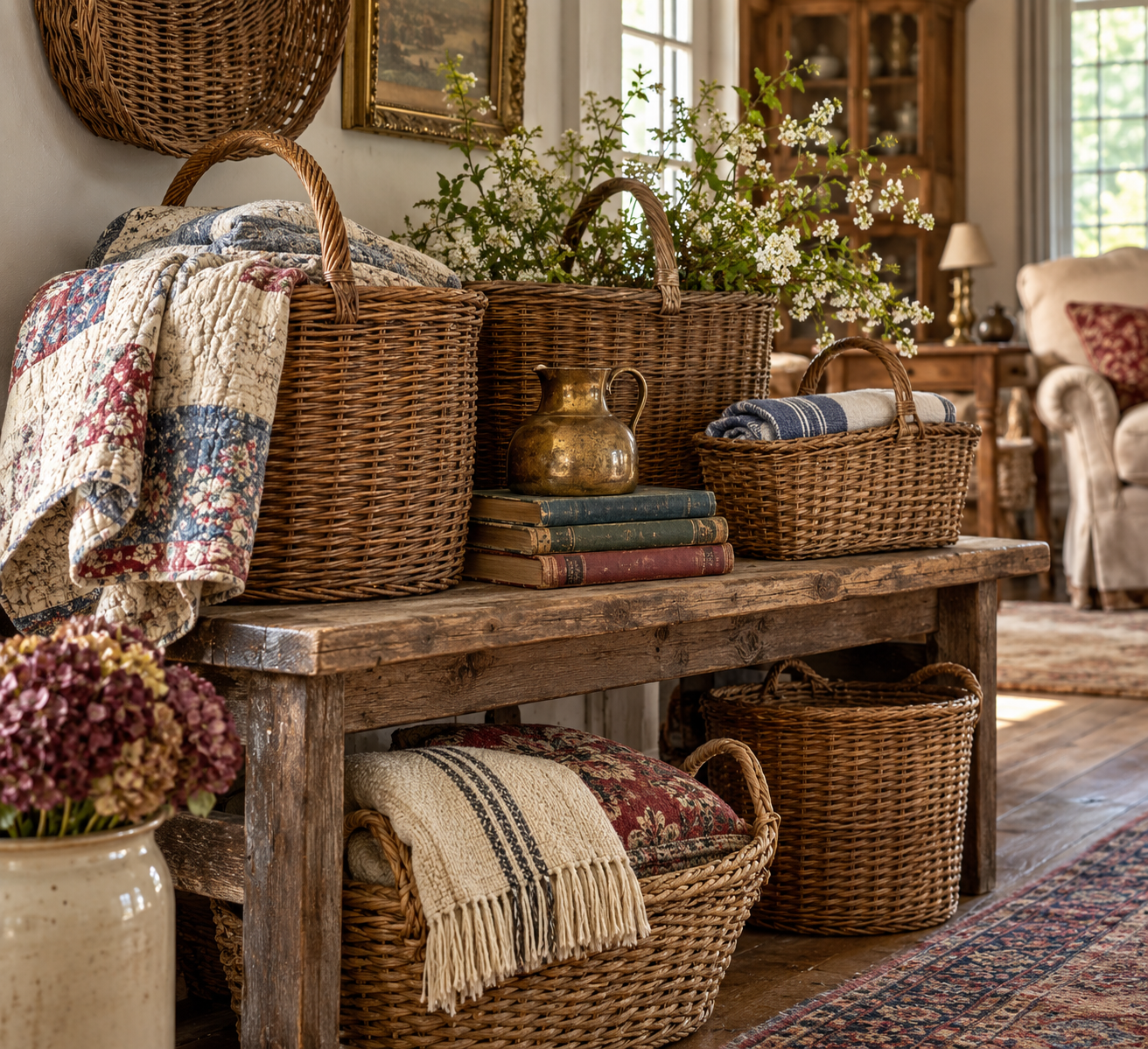
There’s something about an old woven basket that instantly makes a room feel warmer.
Maybe it’s the worn handle, the slightly uneven weave, or the way an old basket looks as though it has already lived a whole life before finding its way into your home. Unlike perfectly matched storage containers, baskets bring texture, age, and a little bit of imperfection—and those are often the details that make a home feel collected rather than decorated.
The best part is that beautiful baskets don’t have to be expensive. Thrift stores, flea markets, estate sales, antique shops, and even newer vintage-inspired pieces can all be mixed together.
And they don’t have to sit around just looking pretty. Some of the loveliest ways to decorate with baskets are also the most useful.
Here are 7 simple ways to use vintage baskets to give your home that warm, lived-in feeling.
1. Fill a Big Old Basket With Quilts and Throws
One of the easiest ways to use a beautiful basket is also one of the most practical.
Place a large woven basket beside a sofa, at the end of a bed, or near your favorite chair and fill it with folded quilts and soft throws. Let a little of the fabric show rather than trying to arrange everything perfectly.
Look for baskets with interesting details—old handles, darker aged wicker, unusual shapes, or a weave that isn’t completely uniform. A few scratches and worn spots only add character.
You can mix an old thrifted basket with newer blankets, too. That combination of old and new is what helps a room feel as though it came together naturally over time.
2. Hang Baskets on the Wall Instead of Artwork
Baskets don’t always have to be used for storage. An old woven basket can be just as beautiful on the wall as a framed picture.
Try hanging one larger basket by itself, or group two or three baskets in different shapes and sizes. Flat gathering baskets, shallow round baskets, and old market baskets are especially pretty this way.
The trick is not making them match too perfectly. Different weaves, slightly different shades of brown, and signs of age make the grouping feel collected rather than like a matching wall-decor set.
They can look especially charming above a console table, beside an old cabinet, in an entryway, or on a small stretch of wall that needs a little texture.
And don’t worry about filling every empty space. One beautiful old basket can sometimes have more character than an entire gallery wall.

3. Use Baskets on Top of Cabinets and Armoires
The top of an old cabinet, hutch, or armoire is one of those spots that can be surprisingly hard to decorate. A basket works beautifully because it adds height and texture without making the space feel cluttered.
Try one substantial basket rather than lining up several small decorations. An old market basket, lidded basket, or loosely woven gathering basket can soften a large piece of furniture and make it feel more at home in the room.
You can leave the basket empty or tuck in something simple like folded linens. The goal isn’t to create a perfect display—it should look as though the basket has simply found a useful resting place there.
This works especially well when the furniture and basket aren’t exactly the same age or finish. Those little differences help create the layered, collected feeling we love at Cartecay James.
Love the warmth old baskets bring to a room? I’ve gathered some of my favorite woven and vintage-inspired finds for creating that same collected look at home.
4. Turn a Gathering Basket Into a Simple Seasonal Display
A beautiful basket can change with the seasons without turning into a big decorating project.
Try an old gathering basket on a table, bench, sideboard, or kitchen island. Fill it loosely with things that feel natural to the season—branches in spring, garden flowers in summer, little pumpkins in fall, or evergreen clippings and pinecones in winter.
You don’t need much. In fact, keeping it a little sparse often makes an older basket stand out more.
For fresh flowers or greenery, tuck a jar or small vase of water inside the basket rather than putting water directly against the weave.
And when the season changes, simply empty it and start again. The basket stays; only the little things gathered inside it change.

5. Use Pretty Baskets for the Things You Actually Live With
Some of the best decorating pieces are the ones that quietly hide everyday clutter.
A basket beside the sofa can hold magazines, books, remotes, or a half-finished knitting project. A smaller basket near the door can catch gloves and scarves, while one tucked under a console table can hold dog leashes or other things you reach for every day.
In a bedroom, baskets are lovely for extra linens or pillows. In a bathroom, a sturdy basket can hold rolled towels or unopened toiletries.
Instead of trying to hide every sign of everyday life, give those everyday things a beautiful place to belong.
That’s part of what makes an old-fashioned home feel so welcoming—it can be pretty without looking as though nobody actually lives there.
Beautiful storage can be useful, too. I’ve gathered some of my favorite woven baskets and charming home finds for adding practical storage without losing that warm, collected look.
6. Mix Different Basket Shapes Instead of Buying a Matching Set
A room feels much more interesting when the baskets look as though they were found at different times.
Mix a tall market basket with a shallow gathering basket, a little handled basket, or an older darker wicker piece. Some can be tightly woven while others are loose and rustic. Even the colors can vary from pale honey to deep aged brown.
Try not to worry about whether every basket coordinates perfectly. The differences are what give the room character.
This is also a wonderful excuse to pick up an unusual basket when you spot one at a thrift store, flea market, or antique shop. You don’t necessarily need to know where it will go right away. Sometimes those unexpected finds become the pieces you love most.
A home filled with things collected slowly will almost always feel warmer than one filled with things bought as a matching set.

7. Let an Old Basket Be Beautiful All by Itself
Not every basket needs to hold something.
If you find one with a beautiful weave, an unusual handle, or years of natural wear, let the basket be the decoration. Place it on an old bench, lean it against the wall beside a cabinet, or set it on a shelf where you can appreciate its shape and texture.
A little fading, a slightly crooked handle, or a darker spot in the weave doesn’t necessarily need to be hidden. Those imperfections are often what make an older piece interesting.
The goal isn’t to fill every basket or style every corner. Sometimes the simplest thing you can do is give a beautiful old piece enough space to be noticed.
A Collected Home Doesn’t Need to Match
Vintage baskets are one of those simple things that can make a home feel warmer without making it feel overly decorated.
Use them for blankets. Fill them with things your family actually uses. Hang one on the wall. Bring one home from a flea market simply because you love it.
Mix old baskets with newer pieces, different weaves, different shades of wicker, and things you already own.
Over time, those little finds begin to tell the story of your home—and that’s far more interesting than having everything match.
At Cartecay James, that’s the kind of decorating we love most: useful, imperfect, collected slowly, and meant for real life.
Looking for a few pieces to start—or add to—your own collection? I’ve gathered some of my favorite baskets and vintage-inspired home finds in one place.
Leave a Reply