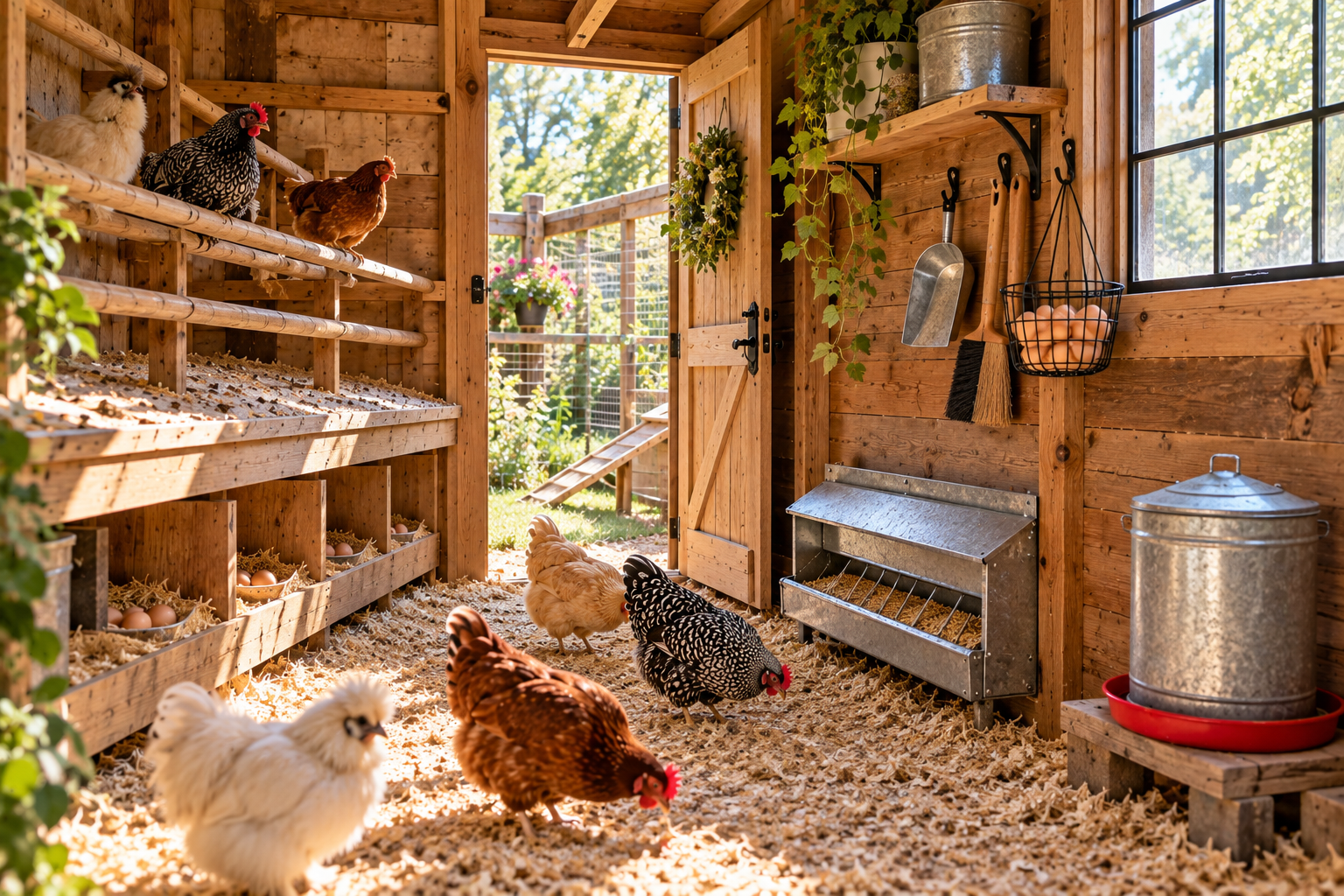
A chicken coop can be adorable in pictures and still be an absolute pain to live with. 😂
When you first set up a coop, it’s easy to think about what it looks like—or even what the chickens need—without thinking quite as much about the person who will be carrying feed, changing water, gathering eggs, cleaning bedding, and checking chickens every single day.
And after you’ve kept chickens for a while, you start noticing the little things that make those chores much easier.
A door that’s actually big enough to walk through comfortably. A feeder that isn’t constantly getting bedding kicked into it. Nesting boxes you can reach without practically crawling inside. Surfaces that don’t take forever to scrape clean.
None of these things are particularly exciting.
But when you’re doing chicken chores in the rain, carrying a bucket in one hand and trying not to trip over three hens under your feet, they suddenly feel very important. 😂
The good news is that you don’t necessarily need an expensive new coop. Many of the best improvements are small changes you can make to the setup you already have.
Here are 10 things that can make a chicken coop easier to clean, easier to use, and much nicer to live with every day—for you and your flock.
1. A Door You Can Actually Walk Through
This sounds almost too simple to include, but a good human-sized door can make an enormous difference.
Tiny access doors might work when you’re reaching in to grab something, but eventually you’re going to need to carry bedding inside, move a feeder, catch a chicken, clean a corner, or inspect something at the back of the coop.
And that’s when a cramped opening becomes frustrating very quickly.
If possible, give yourself an entrance that lets you walk in comfortably without ducking, squeezing sideways, or climbing over a raised board every time.
It’s also worth thinking about the doorway itself. Can you get through it while carrying a bag of shavings? Can you push a wheelbarrow or large muck tub close to it? Does the door stay open while you’re working, or are you constantly fighting with it?
Sometimes the best coop improvements aren’t really for the chickens at all.
They’re the ones that make you think:
“Why didn’t I do this years ago?” 😂🐔
2. Roosts You Can Remove or Easily Reach
Roosts are one of those parts of a coop that seem simple—until you’re trying to clean dried chicken poop off the back side of one in an awkward corner. 😂
If you’re building or changing your coop, make the roosting area easy for you to reach and clean.
Removable roost bars are especially handy. Instead of trying to scrape them while they’re attached to the wall, you can lift them out, clean them properly, let them dry, and put them right back.
Even if your roosts aren’t removable, try to avoid placing them where you have to crawl underneath something or squeeze between walls just to reach them.
And think about what’s underneath the roosts, too.
Since chickens tend to do a lot of their nighttime pooping while they’re perched, this is usually one of the messiest areas of the coop. A removable dropping board or tray beneath the roost can catch much of that mess before it reaches the bedding.
Instead of replacing perfectly good bedding because one area is filthy, you can scrape or empty the board regularly and keep the rest of the coop cleaner longer.
One small design change can turn a big clean-out job into a five-minute chore. ❤️🐔
One little tool that can make coop cleaning much easier: keeping a sturdy scraper near the roosting area makes it much quicker to clean dropping boards, roosts, and other messy spots before buildup becomes a bigger job.

3. Nesting Boxes You Can Reach Without Crawling Into the Coop
Nesting boxes should be comfortable for the hens—but they should also be convenient for you.
If gathering eggs requires squeezing behind a feeder, bending into an awkward corner, or walking through the entire coop every time, it gets old surprisingly fast. 😂
Ideally, nesting boxes should be somewhere you can easily reach, inspect, and clean.
An exterior-access nesting box with a hinged lid can be wonderful because you can collect eggs without even stepping inside the coop. But if your boxes are inside, simply keeping them at a comfortable height and somewhere unobstructed makes a big difference.
You also want to be able to remove dirty nesting material easily.
Eggs break. Hens poop in boxes. Muddy feet happen. And occasionally a hen decides the nesting box is apparently the perfect place to sleep for the night. 🙄😂
Being able to quickly scoop everything out, wipe the box down, and add fresh nesting material makes keeping eggs clean much easier.
One more little trick: don’t make more nesting boxes than you actually need.
The hens will probably ignore half of them anyway and stand in line arguing over the same favorite box. Because chickens. 😂🐔❤️
4. Feeders That Keep Feed Off the Floor
Few things make a coop feel messy faster than feed scattered everywhere.
Chickens are remarkably talented at taking perfectly good feed and somehow kicking, scratching, or flinging half of it onto the floor. 😂 Once it mixes with bedding and droppings, it becomes waste—and spilled feed can also attract rodents and other unwanted visitors.
One of the easiest improvements is simply getting the feeder up off the floor.
A hanging feeder, raised feeder, or wall-mounted setup can help keep bedding from being scratched into the feed while making it harder for chickens to stand inside it and toss everything around.
Placement matters, too.
Keep the feeder somewhere that’s easy for you to refill but away from the busiest scratching areas. You shouldn’t have to crawl into a corner carrying a heavy container of feed every morning.
And if your flock is particularly enthusiastic about wasting feed, a no-waste or port-style feeder can be worth considering.
The goal isn’t to create a fancy feeding system.
It’s simply to have more feed end up inside the chickens instead of underneath them. 😂🐔❤️
Tired of finding more feed on the floor than in the feeder? A wall-mounted or port-style feeder can help keep feed contained, reduce waste, and free up valuable floor space inside a smaller coop or run.
5. Waterers That Don’t Turn Into a Muddy Mess
Chicken water has an amazing ability to go from fresh and clean to full of bedding, dirt, and mystery debris in what feels like five minutes. 😂
Where you place the waterer can make a huge difference.
If possible, keep it on a slightly raised, stable surface so chickens aren’t constantly scratching bedding into it. A sturdy paver, low platform, or waterer stand can work well as long as the birds can comfortably reach the water.
You also want the area around it to stay as dry as possible.
Spilled water inside the coop can create damp bedding, odors, flies, and an environment where you really don’t want moisture building up. If your setup allows it, keeping the main water station in a covered portion of the run rather than directly inside the sleeping area can help keep the coop itself much drier.
And whatever type of waterer you use, put it somewhere that’s easy for you to remove, rinse, refill, and carry back.
Because if cleaning the waterer requires an obstacle course every morning, eventually you’re going to wonder who designed this chicken coop.
And unfortunately, sometimes the answer is us. 😂🐔❤️
6. Floors You Can Actually Sweep or Scrape Clean
The floor might not be the prettiest part of a chicken coop, but it can make the difference between a quick clean-out and an all-afternoon project.
A smooth, solid floor is generally much easier to maintain than one with lots of cracks, gaps, or rough areas where bedding and droppings can collect.
Wooden coop floors can work well, but protecting the surface with an appropriate easy-clean covering can make scraping and sweeping much simpler. Some keepers use removable liners or other washable surfaces in particularly messy areas.
Whatever your coop floor is made from, the important thing is being able to get dirty bedding out without fighting the floor underneath it.
Think about the exit route, too. If you can sweep or rake old bedding straight toward a large door and into a muck tub, cart, or wheelbarrow, clean-out day becomes dramatically easier.
And try not to fill the floor with things that have to be moved every time you clean.
The fewer feeders, waterers, random containers, and other obstacles sitting directly on the floor, the easier it is to get in, clean thoroughly, add fresh bedding, and be finished.
Because nobody has ever stood in a dusty chicken coop scraping poop out of a tiny corner and thought:
“I really wish this chore were more complicated.”
7. Storage Right Where You Actually Need It
You don’t need a Pinterest-perfect feed room attached to the coop.
You just need the things you use every day to be easy to grab when you need them.
A few sturdy hooks can hold a small rake, scoop, egg basket, or cleaning brush. A shelf can keep gloves, nesting supplies, and other little necessities off the floor. Feed and treats can stay in secure containers nearby rather than requiring a trip back to the house every time you need something.
The important part is keeping everything organized, dry, and protected from chickens and rodents.
Avoid leaving feed in open bags, and don’t store medications or anything potentially harmful where curious chickens—or other animals—can get into them.
I also love having a dedicated spot for the things that otherwise disappear exactly when you need them:
the feed scoop, the egg basket, scissors, gloves, and that one little scrub brush nobody is allowed to steal. 😂
You don’t need a lot of storage.
You just need enough that chicken chores don’t turn into:
“Where did I put that thing?”
…twelve times a day. 😂🐔❤️

8. Ventilation That Works Without Making the Coop Drafty
A coop can look spotless and still become unpleasant surprisingly quickly if moisture and stale air have nowhere to go.
Chickens create moisture simply by breathing, and droppings add even more. Without enough ventilation, humidity and ammonia can build up inside the coop—especially overnight when everyone is tucked inside together.
Good ventilation allows that warm, damp air to escape above the chickens while avoiding a cold breeze blowing directly across them as they sleep.
High vents near the roofline are especially useful because warm, moist air naturally rises. Depending on your coop, screened openings beneath the eaves or other protected high vents can provide airflow without leaving the flock exposed to rain or predators.
And don’t permanently close every vent just because winter arrives.
Chickens generally handle cold weather much better than a damp, poorly ventilated coop. The goal is fresh air without a direct draft across the roosting area.
One easy clue is your nose.
If you walk into the coop and immediately smell strong ammonia, something needs attention—whether that’s more ventilation, wetter-than-usual bedding, overcrowding, or simply a cleaning that’s overdue.
A chicken coop doesn’t need to smell like a candle shop. 😂
But it shouldn’t knock you backward when you open the door either. 🐔❤️
9. A Setup That Makes Bedding Changes Easy
Fresh bedding is one of those chicken chores that isn’t difficult in theory.
It’s the getting the old bedding out that can make you regret every decision you’ve ever made. 😂
A coop that’s easy to clean should give you a simple path from dirty bedding to wherever it’s going next.
If possible, arrange things so you can rake or shovel bedding toward a large door instead of carrying little armfuls through a narrow opening. Being able to park a wheelbarrow, garden cart, or large muck tub right outside the door makes the job even easier.
It also helps to keep your fresh bedding somewhere nearby and dry. There’s nothing quite like realizing the coop needs new shavings and discovering the bag you left outside has turned into a giant wet brick.
Whether you use pine shavings, hemp bedding, chopped straw, or another chicken-safe option, choose something that works well with your coop, your climate, and the way you prefer to clean.
And don’t feel like you need to completely strip every inch of bedding on an arbitrary schedule just because someone online says you should.
Watch the condition of the coop instead. Remove wet or heavily soiled areas promptly, keep an eye on odor and moisture, and do deeper clean-outs when your setup actually needs them.
The best cleaning routine isn’t necessarily the fanciest one.
It’s the one that’s easy enough that you’ll actually keep doing it. ❤️🐔
10. A Coop Designed Around Your Daily Routine
This might be the most important thing on the list.
A chicken coop doesn’t have to look like anyone else’s coop. It needs to work for your chickens, your property, and the chores you actually do every day.
Think about your normal routine.
Where do you enter carrying feed? Where do you gather eggs? Where do you stand while filling the waterer? Where does dirty bedding go? Which door do you open first thing in the morning and close again at night?
Those little routines can tell you exactly where your coop is making life harder than it needs to be.
Maybe you need a hook beside the door for the egg basket. Maybe the feed container belongs closer to the run. Maybe moving the waterer ten feet would save you from carrying a heavy bucket across the yard every morning.
And sometimes the best improvement isn’t something you buy at all.
It’s simply moving something to where you naturally reach for it.
A good chicken coop should work with you—not make every simple chore require three extra steps.
So before you worry about whether your coop is Pinterest-worthy, ask yourself a much more useful question:
Does this setup make taking care of my chickens easier?
If the answer is yes, you’ve probably designed a pretty good coop. ❤️🐔
A Good Chicken Coop Should Make Your Life Easier
The best chicken coop isn’t necessarily the biggest, prettiest, or most expensive one.
It’s the one that works.
It’s a coop where you can gather eggs without climbing over things, refill the feeder without spilling half the bag, clean out dirty bedding without turning it into an all-day project, and walk away knowing your chickens have a clean, dry, comfortable, and secure place to live.
And if your current setup doesn’t work that way yet, you don’t have to rebuild everything.
Start with the chore that annoys you the most.
Move the feeder. Add a hook. Raise the waterer. Put a tray beneath the roost. Create a better place for your supplies. Make one small change and see whether it makes tomorrow’s chores a little easier.
Over time, those little improvements can completely change how a coop functions.
Because keeping chickens already comes with enough surprises.
The coop itself doesn’t need to be one of them. 😂❤️🐔
Looking for practical things that make everyday chicken keeping a little easier? I’ve gathered my favorite coop, feeding, cleaning, enrichment, and flock-care finds in one place.
;
Leave a Reply